As distribution businesses expand across multiple regions, managing distributors, dealers, retailers, and field teams becomes increasingly challenging. Every new distribution partner introduces additional approvals, reporting structures, operational responsibilities, and data access requirements. Without a well-defined hierarchy, businesses often experience inconsistent operations, unauthorized transactions, delayed decision-making, and limited visibility across the distribution network.
This is where Distribution Management Software plays a critical role. A modern Distribution Management System (DMS) helps businesses establish a structured distribution hierarchy while ensuring every user has access only to the information and actions relevant to their role. The result is better governance, improved collaboration, and a scalable distribution network that can support long-term business growth.
Why Managing Multi-Tier Distribution Networks Is Challenging
As organizations grow, their distribution networks naturally become more complex. A manufacturer may operate through Master Distributors, Zonal Distributors, Area Distributors, Dealers, and Retailers, with each level responsible for serving a specific geography and customer base.
Without a structured operating model, businesses often face challenges such as:
- Unauthorized inventory transfers between territories.
- Inconsistent pricing across distributors.
- Approval delays that slow business operations.
- Duplicate order processing.
- Limited accountability across channel partners.
These issues become even more difficult to manage as businesses expand into new markets or onboard additional distribution partners.
A distribution network doesn't become complex because it has more distributors — it becomes complex when roles, responsibilities, and approvals are not clearly defined.
What Is a Multi-Tier Distribution Hierarchy?
A multi-tier distribution hierarchy defines how products, orders, approvals, information, and responsibilities move across the distribution network. Every participant operates within a clearly defined structure, ensuring consistency, accountability, and operational control.
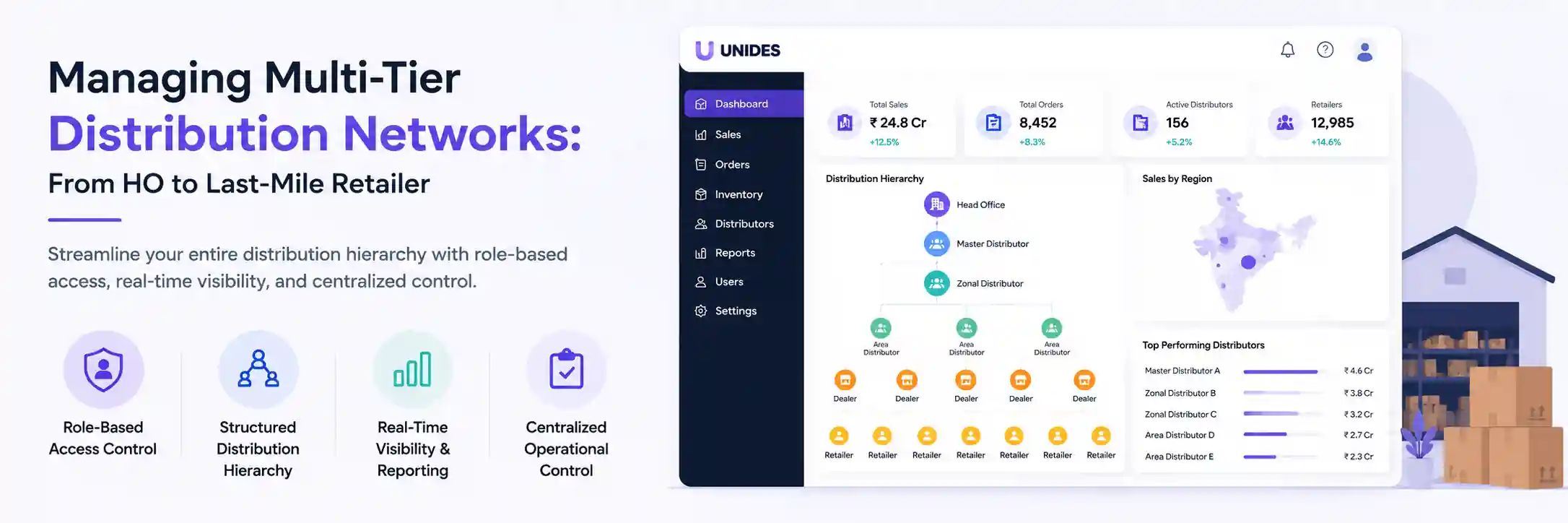
A typical enterprise distribution hierarchy includes: Head Office → Master Distributor → Zonal Distributor → Area Distributor → Dealer → Retailer. Each level has specific operational responsibilities while remaining accountable to the level above it.
For example, a retailer should be able to place orders, track deliveries, and review purchase history. A Zonal Distributor should have visibility into inventory, sales performance, and dealer activities within their assigned territory. Meanwhile, the Head Office requires enterprise-wide visibility to monitor inventory, sales, and operational performance across the entire distribution network.
Three Business Challenges Distribution Management Software Solves
1. Prevents Unauthorized Operations
Without role-based controls, users may access information or perform actions beyond their responsibilities. Modern Distribution Management Software ensures that every user can only access authorized inventory, pricing, approvals, and business data, reducing operational risks and maintaining process discipline.
2. Improves Accountability Across the Distribution Network
Every order, inventory movement, approval, and pricing update is linked to the responsible user. This creates complete traceability, simplifies audits, and enables businesses to monitor distributor and dealer performance with confidence.
3. Supports Scalable Business Growth
As businesses enter new territories, additional distributors and dealers can be integrated into the existing hierarchy without redesigning business processes. A structured hierarchy enables organizations to expand their distribution network while maintaining operational consistency and governance.
Traditional Distribution Management vs Distribution Management Software
To understand the value of a modern DMS, it helps to compare it with how distribution networks are traditionally managed. The differences are significant across every dimension of operations.
| Traditional Distribution Management | Modern Distribution Management Software |
|---|---|
| Manual reporting hierarchy | Configurable multi-tier hierarchy |
| Broad user permissions | Role-based access control |
| Limited operational visibility | Centralized distribution visibility |
| Manual approval processes | Automated approval workflows |
| Difficult to scale | Built for enterprise growth |
The difference extends beyond technology. A structured Distribution Management System (DMS) enables organizations to standardize operations, improve collaboration, and maintain control as the business grows.
Key Features of Distribution Management Software
Modern Distribution Management Software provides capabilities such as:
- Configurable distribution hierarchy for Head Office, distributors, dealers, and retailers.
- Role-based access control for secure data visibility.
- Automated approval workflows for orders, pricing, and inventory.
- Territory-wise distribution management with controlled permissions.
- Performance dashboards for every hierarchy level.
- Centralized distribution network visibility.
- Scalable architecture to support business expansion.
These capabilities help businesses improve governance while reducing operational complexity across the distribution channel.
Why Structured Distribution Networks Create a Competitive Advantage
Organizations with structured distribution networks respond faster to market demands because responsibilities are clearly defined and business processes remain consistent across every region.
Business leaders gain complete visibility into distributor performance, inventory movement, dealer activities, and operational bottlenecks from a single platform. This improves decision-making, strengthens channel relationships, reduces operational conflicts, and enables sustainable business growth.
How UNIDES ERP Supports Distribution Management
UNIDES ERP provides a comprehensive Distribution Management Software solution that helps businesses manage complex distribution networks through configurable hierarchy structures, role-based access controls, and centralized operational visibility.
From the Head Office to the last-mile retailer, every stakeholder operates within clearly defined responsibilities while business leaders gain complete control over inventory, orders, approvals, and distributor performance.
Designed to be easy to customize and fast to implement, UNIDES ERP helps organizations strengthen distribution governance without disrupting existing business operations.
Conclusion
Managing a growing distribution network requires more than simply adding new distributors or entering new markets. It requires a structured system that defines responsibilities, controls access, standardizes approvals, and improves visibility across the entire distribution ecosystem.
By implementing modern Distribution Management Software, businesses can build a scalable, transparent, and efficient distribution network that supports long-term operational excellence and sustainable growth.
Business Insights: A distribution network grows through expansion, but it succeeds through structure. Clear hierarchy and controlled access transform complex distribution operations into a scalable business advantage.